
Walk into most retail stores today and you’ll notice something interesting.
The lighting is right. The fixtures feel premium. The layout looks well thought out.
And yet, something doesn’t click.
Customers hesitate. They wander without direction. They miss products that should have stood out. And often, they leave without buying.
This gap between how a store looks and how it performs is more frequently seen than we’d like to admit. And it usually comes down to one simple reason:
Retail stores are often designed without the most important person in the room: the customer, something even a seasoned retail design agencies quickly identifies when evaluating why a space fails to convert.
Why the Customer Is Missing from the Design Process
In most design disciplines, the end user actively shapes the outcome.
Homes are built around the routines and preferences of the people who live in them. Office spaces are planned based on how teams work, collaborate, and move through their day. In both cases, design decisions are grounded in real usage patterns.
Retail, however, doesn’t always follow the same approach.
The customer, the person who is ultimately the one navigating the store, interacting with products, and making purchase decisions, is typically absent from the design process. Instead, decisions are often driven by internal alignment: business priorities, brand interpretation, operational convenience, and stakeholder preferences.
While these inputs are important, they tend to focus on how the store should be rather than how it will be experienced.
This creates a subtle but critical gap.
Without a clear understanding of real customer behavior, how people move, what they notice, where they hesitate, design faces the risk of becoming an exercise in assumption rather than insight. In a physical retail environment, even small misalignments between design intent and customer behavior can directly impact engagement and sales.
When Assumptions Start Driving Design
In the absence of the customer, assumptions quietly fill the gap.
The layout feels clean on paper. A display looks premium in a render. A section seems logically placed within a plan.
This is often where even experienced retail design agencies can unintentionally miss the mark.
These decisions are rarely wrong in intention. But intention alone doesn’t determine how a store performs.
Because customers don’t engage with intent; they engage with experience.
They don’t stop understanding why something is placed in a certain way. They don’t analyze visual hierarchy or appreciate design rationale. They move instinctively. They scan quickly. They decide in seconds.
And if the space doesn’t support that natural behavior, friction creeps in.
In retail, even small friction points can have a disproportionate impact. A confusing pathway, a missed product, a moment of hesitation, each one quietly reduces the likelihood of purchase.
What Really Happens on the Shop Floor
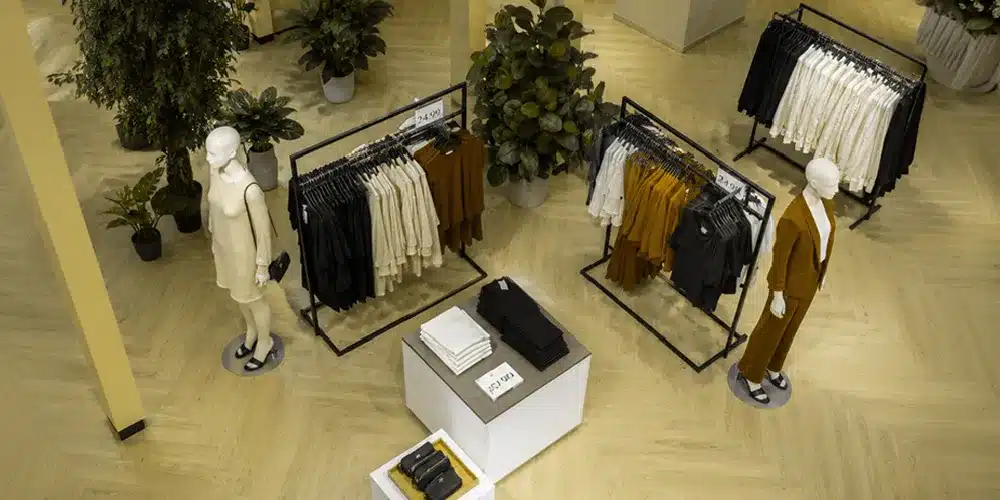
Every retail concept, no matter how well thought out, is ultimately tested in one place, the shop floor.
This is where ideas translate into real experiences. Where layouts either guide or confuse. Where products are either noticed or overlooked. Where customers either engage or disengage.
What looks intuitive on a plan doesn’t always feel intuitive in motion, and this is exactly where a skilled retail design agency steps in, bridging the gap between design intent and real customer behavior.
A customer entering a store isn’t thinking in terms of zones or categories. They are trying to make quick sense of the environment. Where do I go? What’s here? Is this worth my time?
If the space answers these questions effortlessly, the customer settles in. If it doesn’t, they begin to drift, often missing key sections altogether.
The same applies to visibility. Simply placing products in a store does not guarantee they will be seen. Customers don’t scan every shelf or explore every aisle. They notice what stands out, what feels accessible, what enters their natural line of sight.
And beyond visibility lies engagement. The longer a customer stays, the more they discover. But people don’t spend time in spaces that feel overwhelming or mentally taxing. They stay where things feel clear, comfortable, and easy to navigate.
Even interaction follows this pattern. Products that are easy to approach, reach, and understand are far more likely to be picked up. Those that require effort, physical or cognitive, are often ignored.
None of this is accidental. It is all shaped by design, and by how effectively a retail experience design agency translates behavior into space.
Why Good-Looking Stores Still Underperform
One of the most persistent misconceptions in retail is equating good design with good aesthetics. Even many businesses working with a store design agency fall into this trap.
A store can look refined, modern, even impressive, and still fail to perform.
Because visual appeal alone does not drive buying behavior.
A beautifully designed space that confuses customers will underperform. A simpler space that guides them effortlessly will almost always do better.
This is the difference between a store that looks good and a store that works.
And in retail, working matters more.
Moving from Opinion to Real Customer Insight
If internal perspectives are not enough, what should guide design decisions?
The answer lies in observing real customer behavior.
Not imagined journeys, but actual ones.
How do people move through the store? Where do they slow down? What do they skip entirely? At what points do they disengage?
These observations often challenge assumptions. Areas that seemed important on paper may receive little attention. Spaces that were not designed as focal points may naturally draw customers in.
This shift, from opinion to observation, is where more effective retail design begins, especially for brands planning scale through retail design for multi store expansion.
How Shop Pros Turns Insight into Action
Recognizing the problem is one thing. Addressing it consistently across projects is another.
Many teams acknowledge the importance of customer-centric design, but struggle to translate it into a clear, repeatable process. This is where the gap between intent and execution often appears.
At Shop Pros, the approach is built around closing this gap.
As a retail design agency, Shop Pros goes beyond aesthetics to focus on how spaces actually perform.
Instead of designing based on assumptions or individual preferences, the focus is on aligning every decision with how customers behave in physical environments. This becomes especially critical when working across formats, locations, or large-scale rollouts, whether for brands in Delhi NCR or across India.
This is also where structured thinking, similar to what a retail format standardization consultant would bring, becomes essential.
To make this approach consistent and scalable, Shop Pros follows a structured framework.
The 4D Approach to Customer-Centric Retail Design
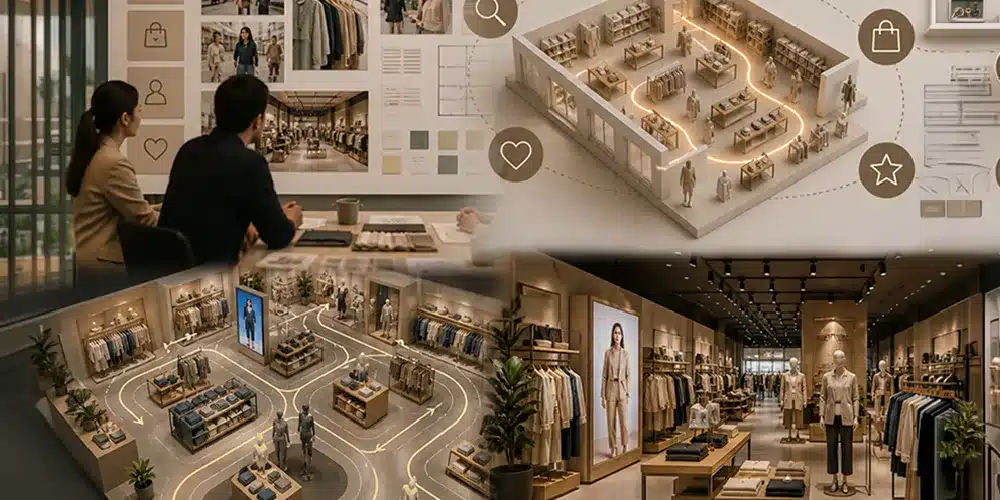
The 4D approach is not just a process; it is a way of ensuring that customer experience is built into every stage of retail design.
It begins with Discover, where the focus is on deeply understanding the brand, the product mix, and the intended customer. Beyond business inputs, this stage also looks at expectations, what customers are likely to seek, how they prefer to navigate, and what might create friction.
This is followed by Define, here insights are converted into a clear strategic direction for the store and the role it plays in the portfolio. This includes defining the experience positioning, prioritizing journeys and touchpoints, and setting the guardrails that will guide every design and layout decision that follows.
With these insights in place, the process moves into Design. Here, decisions become more intentional. Layouts are structured to guide natural movement. Displays are positioned to enhance visibility, zoning, and storytelling. Zones are planned to reduce confusion and improve flow. Aesthetics remain important, but they are aligned with performance, not separated from it.
Finally, Deliver ensures that everything envisioned translates accurately on the shop floor. Even the most well-thought-out design can lose its impact if execution falls short. Attention to detail, consistency, and alignment with the intended experience becomes critical at this stage.
From Aesthetic Spaces to High-Performing Stores
What this approach ultimately does is shift retail design from being subjective to being structured.
It reduces reliance on personal preferences and replaces it with clarity, clarity driven by customer behavior, spatial logic, and real-world interaction.
The result is not just a store that looks appealing, but one that actively supports business outcomes, something leading retail design companies in Delhi NCR and across India are increasingly prioritizing.
Designing for How Customers Actually Behave
There is often a gap between how a store is intended to be experienced and how it is actually experienced. Something a retail store capex optimization consultant immediately identifies when evaluating real-world performance.
Designers understand the logic behind decisions. Customers don’t.
They respond to what feels easy, what feels clear, and what feels natural in the moment.
This is why effective retail design focuses less on planned journeys and more on real ones, less on assumptions and more on observed patterns.
Because in the end, reality always overrides intention.
Finding the Balance Between Brand and Usability
A common concern in retail design is how to maintain brand identity while optimizing for usability.
The two are not mutually exclusive, but they do need to be carefully balanced.
A strong brand presence creates recall and differentiation. But if it comes at the cost of clarity or ease of use, it can work against the store.
Overly stylized fixtures can reduce visibility. Complex layouts can disrupt navigation. Minimalist approaches can sometimes limit discovery.
The goal is not to dilute the brand, but to ensure that it enhances the customer experience rather than complicates it.
A Simple Question That Changes Everything
At its core, improving retail design often comes down to a simple shift in perspective.
Instead of asking, “Do we like this?”
Ask, “How will a customer experience this?”
That one question aligns decisions, reduces bias, and brings focus back to what truly matters.
Why This Matters More in Today’s Retail Landscape
Customers today have more options than ever before. Online platforms offer convenience, marketplaces offer variety, and quick commerce offers speed.
For physical retail to remain relevant, it needs to offer something more.
Not just in terms of ambiance, but in terms of ease, clarity, and comfort.
It needs to make the journey from entry to purchase feel effortless.
Stores that achieve this don’t just attract customers; they convert them.
What Ultimately Defines a Successful Store
Retail design is not judged in presentations or walkthroughs.
It is judged on the shop floor.
- By how customers move.
- By what they notice.
- By what they engage with.
- And by what they choose to buy.
Because customers don’t see the design process.
They experience the outcome.
Designing for the Outcome That Truly Matters
Designing a retail store without deeply considering the customer is like building a product without understanding the user.
It might look right.
But it won’t work right.
The most successful retail spaces are not the ones that impress internally. They are the ones that perform externally, where it matters most.
At Shop Pros, this belief shapes every conversation, every layout, and every decision.
Because when design begins with the customer, it doesn’t just look better.
It works better.
Frequently Asked Question
Q1. What does a retail experience agency do beyond interior design?
Q2. When should a brand bring in a retail experience agency?
Q3. Why should retail design begin with the customer?
Q4. Does retail experience design help with multi-store expansion and standardization?
Conclusion
Ready to turn your stores into high-performing retail experience assets, not just well-designed spaces? Connect with Shop Pros, a strategic retail design agency to audit your current formats and build an experience-led retail‑ design roadmap for your next phase of growth. Book a working session with our retail experience team and see where your stores are leaving value on the shop floor today.